Executive Summary
· Markets enter 2026 cautiously optimistic, with rate-cut expectations firmly embedded across developed economies.
· Central banks signal patience, balancing easing inflation against fragile growth.
· Global equities start the year mixed, supported by policy expectations rather than earnings momentum.
· Valuations remain a key differentiator: UK and Europe offer value, while U.S. concentration risk persists.
· Gold and real assets retain relevance amid policy uncertainty and geopolitical risk.
Global Equities Context
Global equity markets began 2026 in a measured but constructive fashion. In the U.S., investors remain focused on the timing and pace of Federal Reserve rate cuts, with optimism tempered by high valuations and narrow market leadership. UK and European equities continue to benefit from relative value appeal, as investors seek diversification away from the most expensive global markets. In Asia, Japan remains a beneficiary of ongoing corporate reforms and improving capital discipline, while India continues to stand out as a long-term growth leader driven by domestic demand rather than global trade. Overall, equities remain supported by expectations of easier monetary policy, but vulnerability to earnings disappointment remains elevated.
Central Banks: Easing Expected, But Not Rushed
As the year opens, central banks appear aligned in principle but cautious in execution. The Federal Reserve has reinforced that inflation is moving closer to target, yet policymakers remain reluctant to move too quickly given residual price pressures and geopolitical uncertainty. Markets continue to price in multiple cuts during 2026, but the Fed’s messaging suggests a gradual and data-dependent path.
In the UK, the Bank of England maintained the base rate at 3.75%, with commentary increasingly focused on growth risks rather than inflation persistence. While policymakers acknowledge that inflation has eased materially from its peak, concern remains that premature easing could undermine progress. The direction of travel is clear, but the timing remains finely balanced.
UK: Disinflation Helps, But Momentum Remains Weak
UK inflation continues to trend lower, providing modest relief to households and businesses. However, economic momentum remains subdued. Consumer confidence is improving only slowly, while business investment remains cautious amid uncertainty over demand and fiscal constraints.
The labour market shows early signs of cooling, which may further ease inflationary pressures but also raises concerns about growth. With public finances stretched and fiscal flexibility limited, monetary policy is likely to remain the primary lever for supporting the economy in 2026 — reinforcing expectations that the next move in rates will be downward.
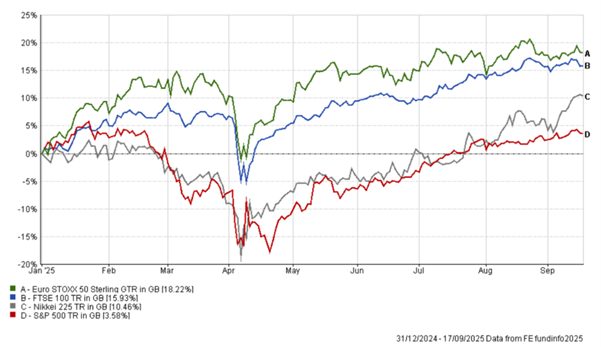
However, the UK Equity market is still performing very well and is expected to continue. Most of the big UK firms earn money globally and are historically undervalued. The FTSE 100 rose above 10,000 for the first time in the New Year and has remained above that level since. Shares prices remain good value and can expect to benefit from the current trend away from the US.
Other viewpoints
Cash
Cash remains competitive in the early part of 2026, but forward-looking returns are likely to fall as rate cuts approach. Investors holding excess cash should consider the opportunity cost of staying defensive as policy begins to loosen.
Fixed Interests
Fixed income continues to regain relevance. Gilt and Treasury yields have stabilised, and the risk-reward profile for high-quality bonds has improved meaningfully compared with recent years. Bonds once again offer diversification benefits alongside income.
Alternatives
Gold remains well supported, reflecting ongoing geopolitical uncertainty, lower real yields and demand for portfolio insurance. Industrial metals remain elevated, supported by structural demand and constrained supply. Alternatives continue to play an important role in managing inflation and volatility risk.
UK Shares
UK equities remain attractively valued, particularly relative to U.S. peers. While domestic demand remains soft, global exposure and currency effects continue to provide support. A clearer path to rate cuts could act as a catalyst for renewed interest later in the year.
US Shares
U.S. equities remain buoyant but increasingly sensitive to expectations. Market leadership remains narrow, and valuations leave little margin for error. While structural growth themes such as AI remain intact, the balance of risks suggests a more volatile environment ahead.
European Shares
European equities continue to offer value and diversification. Lower inflation and stable monetary conditions support the outlook, although growth remains modest. Export-oriented sectors remain well positioned if global conditions stabilise.
Asian Shares
Japan continues to attract international capital, underpinned by reforms and improving shareholder returns. China remains mixed, with selective opportunities but ongoing structural challenges. India continues to stand out as a long-term growth story, supported by demographics, consumption and infrastructure investment.
Emerging Markets
Emerging markets show selective strength, supported by a softer dollar and stabilising global rates. Commodity exporters and reform-oriented economies remain preferred, while high-debt markets continue to face pressure.
Highlights & Risks
Highlights:
· Rate-cut expectations support bonds and equities entering 2026.
· Valuations outside the U.S. remain compelling for diversified portfolios.
· Gold and alternatives continue to provide effective risk mitigation.
· Asia — particularly Japan and India — remains structurally attractive.
Risks:
· Delayed or slower-than-expected rate cuts could unsettle markets.
· U.S. equity concentration and valuation risk remains elevated.
· Weak global growth could pressure earnings across regions.
· Geopolitical shocks or renewed trade tensions could increase volatility.